
You Paid $20 For Emerald's Teenage Fantasy. Don't Let Them Take Your Joy Too.
The academic elitists are mad you enjoyed Jacob Elordi. I refuse... Let's Take It There.

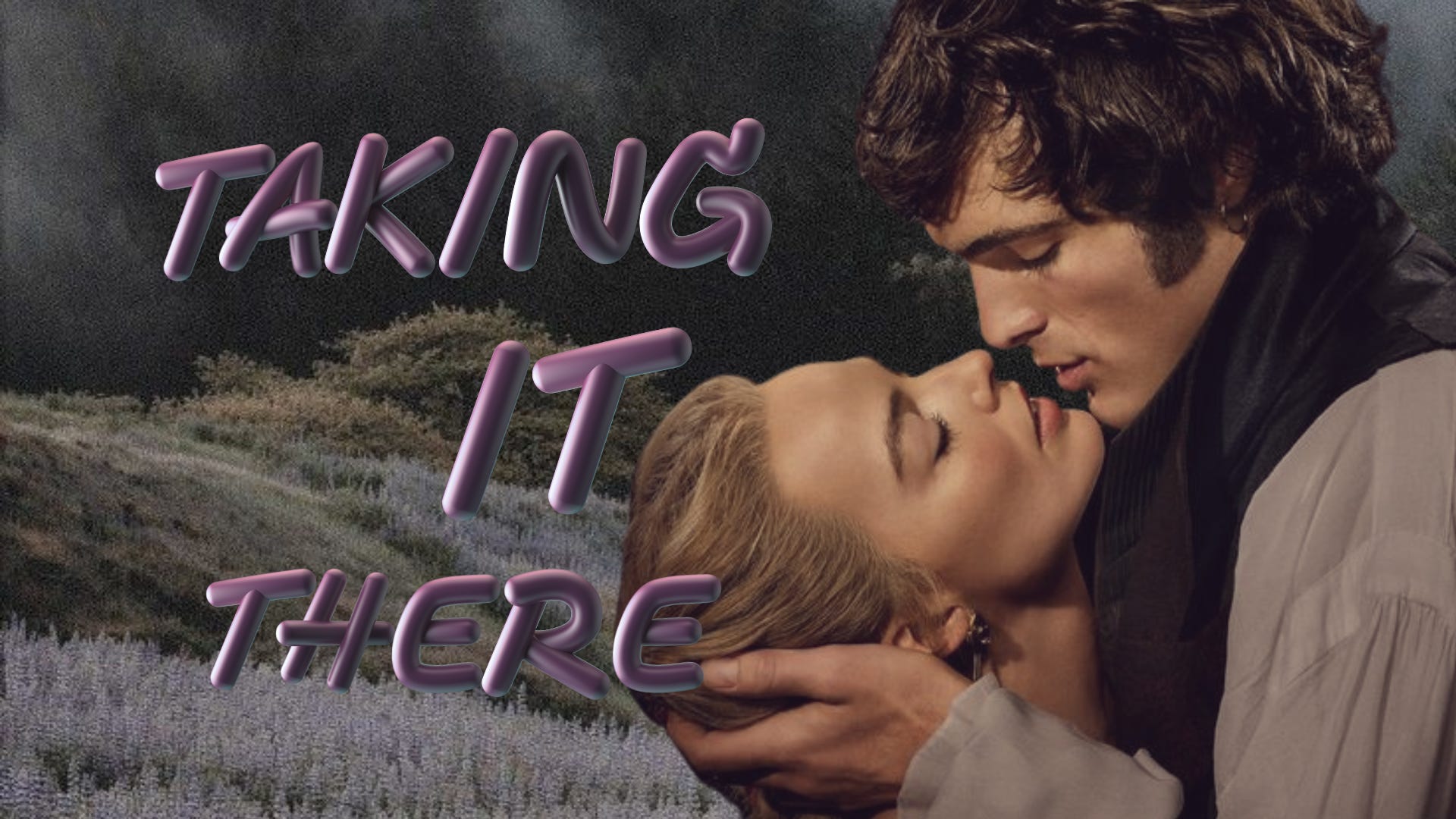
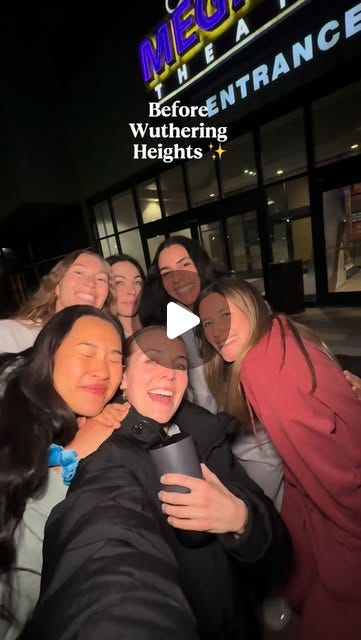
Wuthering Heights valentines weekend is a film studio exec's wet dream. I was there and I need to set the scene for you. Packed theater, genuinely not one empty seat. White girls everywhere, wine in hand, full Galentines activation. Jacob Elordi appeared on screen and the room went absolutely feral. I left the theater genuinely shook, disoriented, not entirely sure what I had just watched. I opened Instagram and these same girls were on all fours. Barking. I am not exaggerating even slightly.
I’ve watched the discourse around Emerald Fennell’s “Wuthering Heights” tip from genuine, necessary criticism into something that started to make me itch. I saw a creator (with a large platform) say that if you enjoyed this film, you are subscribing to white supremacist ideals. I’ve watched film Twitter do what film Twitter does: take a legitimate structural critique and weaponize it into a purity test. Take something that is supposed to be about liberating the text and turn it into a tool for policing the people who enjoyed it.
And I cannot get with that. I won’t.
Here’s what I believe: two things can be true at once. Emerald Fennell’s “Wuthering Heights” falls short of what the source material required, for reasons I’m going to get into, and the black women and girls who sat in that cinema and felt something real and beautiful are not doing anything wrong. Their joy is not a political failure. Their joy is not up for debate.
Bell hooks wrote about what it means to be a black female spectator, about the constant, exhausting negotiation of your own gaze when the images on screen were not made for you and frequently made against you. She wrote about the “oppositional gaze,” the act of looking back critically, of refusing to be absorbed into a cinematic experience that asks you to disappear into it. But hooks also understood that this critical gaze does not preclude pleasure. It doesn’t require you to be miserable as the price of your politics. The negotiation she described was never about renouncing joy. It was about refusing to be unconscious. Those are different things.
When someone tells a Black woman that liking a film, any film, makes her complicit in white supremacy, they are not doing radical work. They are doing the opposite. They are demanding that she shrink her gaze, police her own responses, submit her emotional life to an external tribunal. That is not liberation. That is just a different kind of violence.
So I want to hold both things at once. Fully. Without flinching from either.
There’s a version of Wuthering Heights that has lived in people’s imaginations for a long time. Not on a pinterest moodboard, not in a pitch deck, but in the margins of a dog-eared Penguin Classics edition, in the part of the brain that lights up when you read something that feels, somehow, like it was written about the exact specific injustice you’ve been trying to articulate your whole life. A story about a man who is never quite nameable, his origins ambiguous, his skin dark, his rage a direct inheritance from every person who ever told him he didn’t belong, and the woman who loved him but ultimately chose the respectable house. A story about what class does to desire. What race does to love. What it means to be treated as property and then watch the people who treated you that way crumble, and the abuse that follows.
That film, the one that sits inside the book if you read it with open eyes, is not the one Emerald Fennell made.
And if I am being honest, it was never going to be.
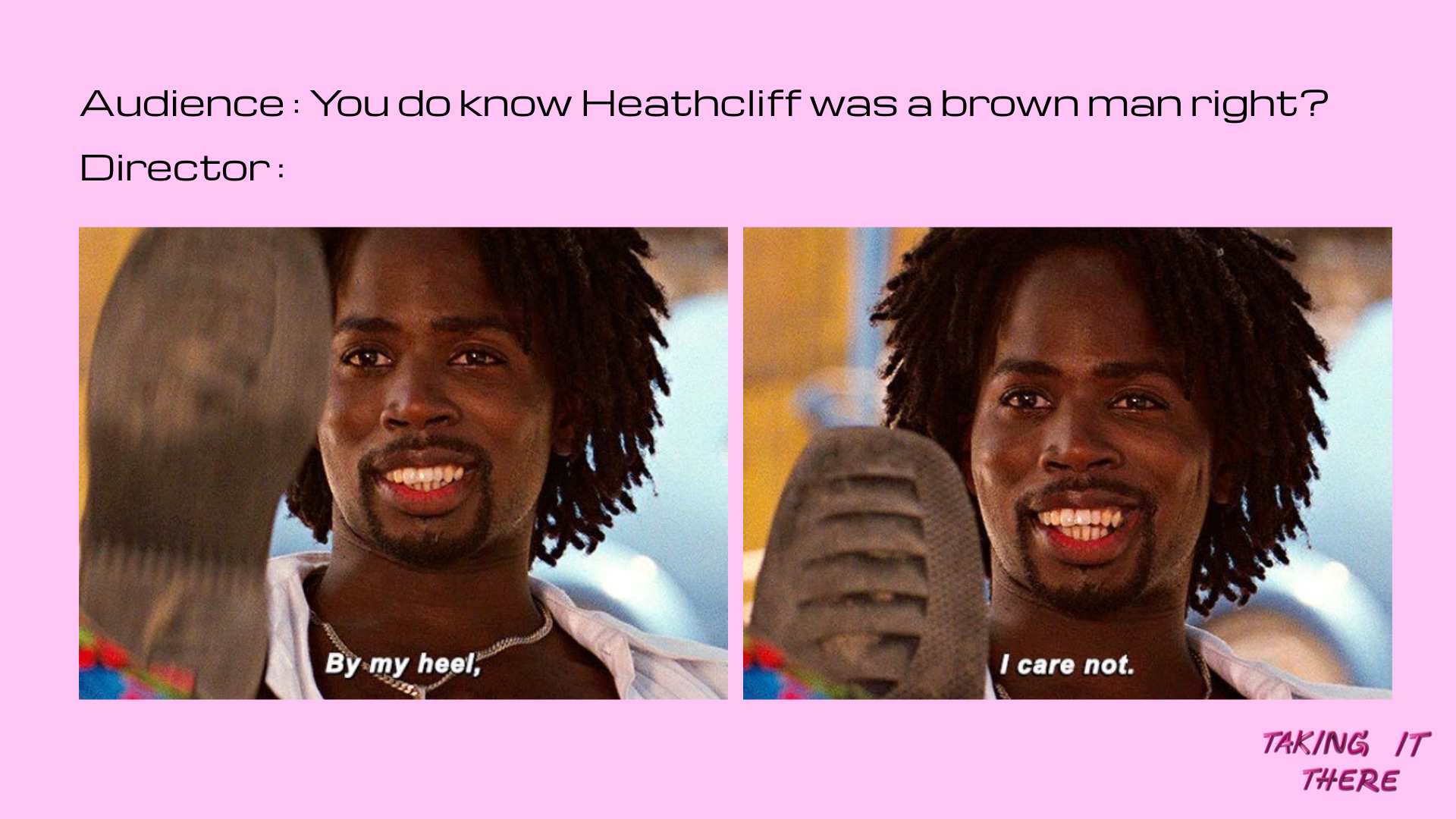
The backlash has been framed as a debate about academic integrity. Did she stray too far from the source material? Is it even Wuthering Heights if Heathcliff is played by a very tall, very white Australian man whose darkness begins and ends at his cheekbones?
But that framing lets Fennell off too easy, because the problem isn’t fidelity. The problem is vision. Specifically, the limit of hers.
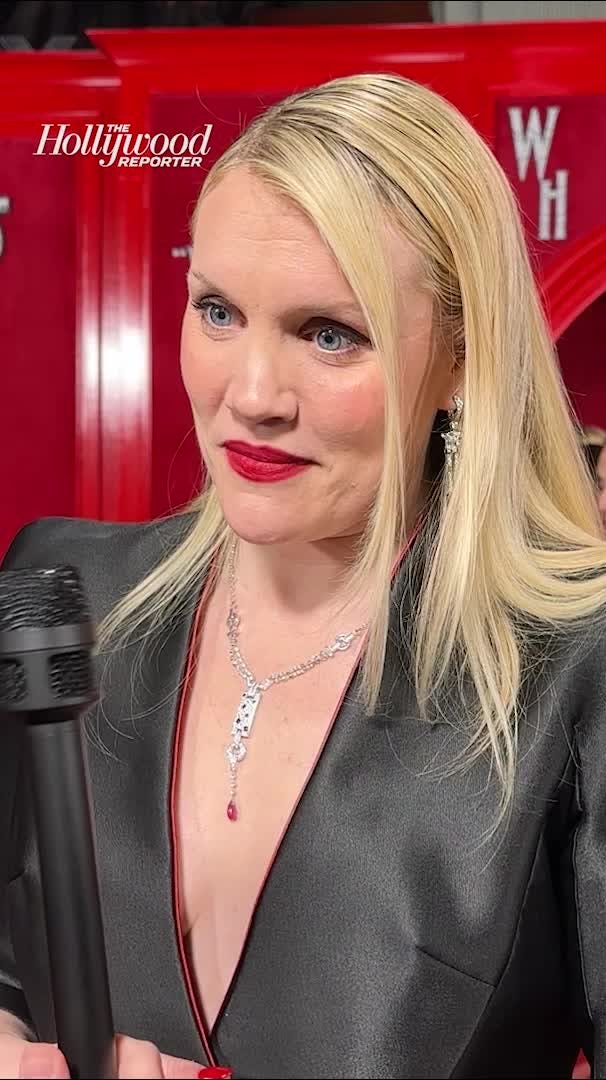
When asked about casting Jacob Elordi, a white actor, in the role of a character that Emily Brontë described as a “dark-skinned gipsy,” a “Lascar,” a figure whose very unknowable origins are the engine of everything that happens in the novel, Fennell said: “You can only ever kind of make the movie that you sort of imagined yourself when you read it.”
Read that again.
 Tiktok failed to load.
Enable 3rd party cookies or use another browser
She imagined Heathcliff as white. She read a book in which a man’s racial otherness is the precise reason the woman he loves won’t fully claim him in public, the reason Cathy tells Nelly that marrying him would degrade her, and she imagined him as white. And she made the movie from that imagination. With a $100 million budget and Margot Robbie as a producer. Released on Valentine’s Day with a Charli xcx soundtrack.
This is not a filmmaker who failed to adapt a complex book. This is a filmmaker who adapted exactly what she saw in it. The problem is what she was incapable of seeing. The blind spot, as it turns out, is the entire architecture of the novel.
There’s a particular kind of privilege that lets you read Wuthering Heights and come away with a teenage fantasy about a beautiful brooding man and the wild woman who loved him. Fennell has spoken openly about her passion for the book since she was fourteen. She wanted to make the film she carried around in her head from those years. The version where the love story is just a love story, intoxicating and doomed, without the machinery of empire grinding underneath it.
That is the luxury of being a wealthy white woman reading the book from a position of comfort. You get to extract the romance and leave the structural analysis in the margins.
Fennell’s filmography makes her perspective legible. Promising Young Woman is a film about a very particular kind of feminist revenge, one that centers white womanhood, individual trauma, and personal vengeance rather than any systemic analysis of why the thing happened in the first place. Saltburn is a film that could have interrogated class violence with real teeth and instead lets its wealthy characters off the hook by framing class resentment itself as the pathology. In both films, the formal filmmaking is dazzling. In both films, the political imagination stops exactly where it would start to become uncomfortable for someone of her background to pursue. The blind spot is consistent. It has a shape.
“Wuthering Heights” is no different. She spotted the sadomasochism in Brontë, correctly, and built a whole visual language around it. She spotted the female interiority, correctly, and gave Cathy more agency than the novel does. She was not wrong about what is in the book. She just couldn’t access the parts of the book that would require her to sit with the discomfort of what her own class and race actually is in this story. Not Cathy. Not even Heathcliff. She’s closer to the Lintons.
The casting of Shazad Latif, a British Pakistani actor, as Edgar Linton, the respectable husband Cathy chooses over Heathcliff, is almost too on the nose to believe. In this version, the “safe” man who represents social legitimacy is a man of color. The dangerous, passionate, low-born outsider is white. Cathy’s fear of degradation, when she says marrying Heathcliff would degrade her, now makes no social sense. The racial logic that Brontë built into the architecture of that confession has been quietly flipped, smoothed over, made into something the movie can’t even acknowledge because it doesn’t have the language to.
Fennell’s race-swapping doesn’t interrogate the text. It accidentally exposes that she never understood the text. This casting looks interesting on the surface and is actually incoherent at the level of meaning. This is what happens when someone with real technical skill and limited political imagination takes on material that requires both.
Here’s the thing I want to be honest about, because I think the discourse has flattened this: the film is genuinely, technically extraordinary in places. And I want to name the people responsible for that, because they deserve it. Production designer Suzie Davies built sets that feel like living, breathing characters. Wuthering Heights itself sweating and crumbling, nature literally pushing through the walls, Thrushcross Grange a gilded cage where every flower is pressed and every surface controlled. Cinematographer Linus Sandgren, shooting on 35mm so that every frame moves and breathes rather than sitting still like a digital image, gave the film a textured, organic quality that earned every sweeping moors shot. And Jacqueline Durran’s costumes, which some have criticized for their anachronism, I actually think are one of the most creatively daring choices in the film. An unashamed reimagination of the period, costumes that privilege feeling and silhouette over historical accuracy, and it works. These three did their jobs magnificently.
The tragedy is that all of that craft is in service of a vision that never arrives.
Because what Fennell was attempting, and I can see exactly what she was going for, was something like what Baz Luhrmann did with Romeo + Juliet in 1996. That film dropped four-hundred-year-old language into a neon, MTV-paced California where the gang warfare was real, the class commentary was embedded in the visual language, and the gender dynamics of the tragedy were interrogated rather than just illustrated. Luhrmann understood that the play is fundamentally about what society does to young people who love the wrong person, and he made a film where you felt that in your body. The anachronism was in service of something. Every stylistic choice was load-bearing.
Fennell’s film wants to be that, and occasionally, frame by frame, it gets there. But then you pull back and realize the anachronism is decorative. The Charli xcx soundtrack is vibe, not argument. She got closer to Sofia Coppola’s Marie Antoinette, another film about a woman trapped by a world she didn’t choose, another film that leaned on pop music and lush period design to make something feel contemporary and female. But even Marie Antoinette, which takes real critical hits for its politics, was at least about something: the isolation of a woman whose interior life was irrelevant to the institution she served. Coppola knew whose story she was telling and why the style was the point.
Fennell’s “Wuthering Heights” is Marie Antoinette with the gender analysis extracted. It’s Romeo + Juliet with the tragedy defanged. It is a hollow version of both, all the beauty of those references, none of the urgency. And the reason it’s hollow is the same reason the casting is incoherent: there’s no argument underneath the gorgeous surface. Just a talented filmmaker’s memory of how a book made her feel when she was fourteen, rendered in the most expensive possible terms.
But here’s where I need to come back to where I started.
The film needed a filmmaker willing to interrogate their own positionality, to ask not just what Heathcliff means to her, but what she would have meant to Heathcliff. What she would have been, in that world, with this wealth and this skin. Emerald Fennell was never going to ask that question. The disappointment is real.
And none of that has anything to do with how you are allowed to feel walking out of the cinema.
Bell hooks didn’t theorize the oppositional gaze so that black women could be policed by other people armed with theory. She theorized it as a form of power: the power to look critically, to refuse erasure, to hold your own perspective in a culture that constantly tries to absorb you into someone else’s. That is a tool for your liberation. It is not a mandatory sentence. It does not mean you owe anyone an apology for the parts that moved you.
The people telling you that enjoying this film makes you complicit in white supremacy are doing something that should make us very suspicious: they are using the language of critique to restrict black women’s emotional freedom. They are saying, in effect, that your responses belong to the discourse before they belong to you. That your feelings require political vetting before they are permitted. That is not intellectual rigor. That is a new cage dressed up as wokeness.
Hong Chau gave an amazingly nuanced performance of Nelly. Suzie Davies’ sets were breathtaking. Jacqueline Durran dressed people like she was designing for feeling rather than the rigidity of the regency era. Jacob Elordi brooded convincingly through the moors. If you loved it, you loved something real. The craft was there.
The vision fell short. The political imagination of the person holding it all together couldn’t carry the weight of the material. That gap, between what the book demands and what Fennell could give, is worth understanding, worth discussing, worth naming with precision.
But joy is not the enemy of that conversation. And the women who felt something sitting in that theater are not the problem. They were never the problem.
The problem is who got to make the film. Not who got to love it.
<3<3<3
If you want to convert your doomscroll into a reading list, checkout my community library where you can build your shelf with a physical copy of the texts referenced in this piece and download free pdf versions.
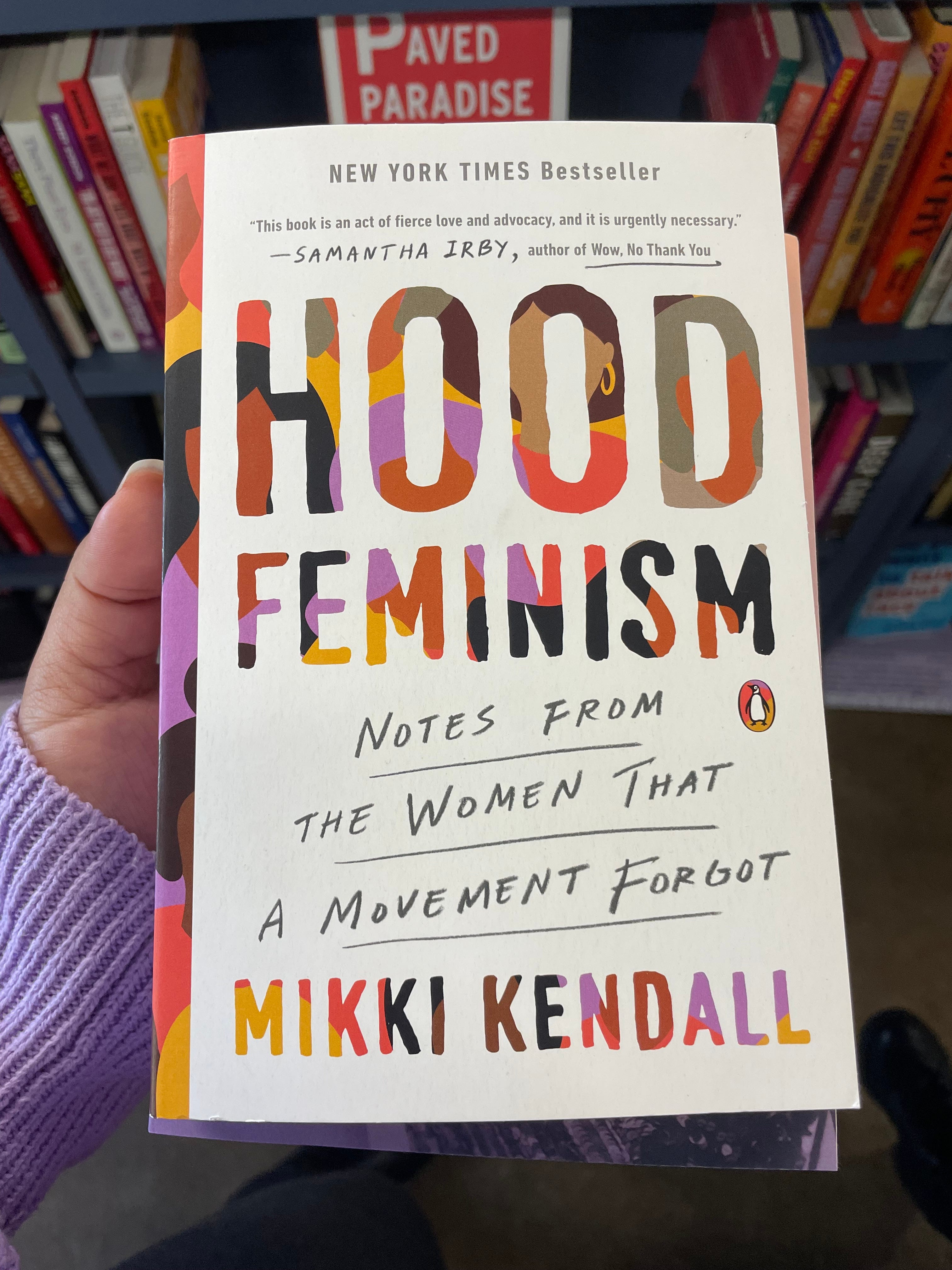
Oh, thank you for the book recommendation!!! I also love the idea of adding a public library to your publication I'm going to save it as a bookmark so I can see what you're reading :) I haven't seen this film but I'm enjoying your analysis of it regardless.